Quick Summary
If you run an online store and want to boost your visibility in 2025’s competitive market, focusing on eCommerce SEO isn’t just about traditional rankings anymore—it’s about adapting to an AI-driven search landscape. This article breaks down best practices for modern SEO, including improving site speed and crawlability, optimizing product and category pages for user intent, creating authoritative content, and preparing for new AI search features like Google’s AI Overviews. You’ll also learn how to leverage structured data, adapt to zero-click trends, and prepare for emerging technologies like voice and visual search—so your eCommerce site stays relevant and visible as search evolves.
Table of Contents
The eCommerce industry is undergoing a profound transformation, driven significantly by advancements in Artificial Intelligence (AI) and evolving user behaviors. For eCommerce businesses, success in 2025 depends on a dynamic Search Engine Optimization (SEO) strategy that extends beyond traditional ranking metrics. While achieving a top organic ranking remains valuable, nowadays, being at the top doesn’t necessarily mean you are getting enough traffic. To stay ahead in the current market, you need to adapt your strategy to attract more customers and engage users in this AI-driven world. In this article, we will explore the eCommerce SEO best practices to stay relevant and capture user attention. Let’s get started!
eCommerce SEO Best Practices
A strong SEO strategy for an eCommerce business in 2025 is based on a few key pillars to ensure the site performs well and offers relevant content to users.
1. Technical SEO Excellence for Speed & Crawlability
Technical SEO is the basic foundation for the success of an eCommerce website. It is essential for efficient bot crawling and a positive user experience. If you lack a strong technical SEO, even high-quality content and top-notch off-page SEO will struggle to maintain traction. As AI-driven search focuses on delivering a real-time user experience, mastering eCommerce SEO best practices in technical areas is crucial. This means the team of developers, marketers, and designers should work together to produce a website that runs seamlessly and meets user expectations in terms of experience.
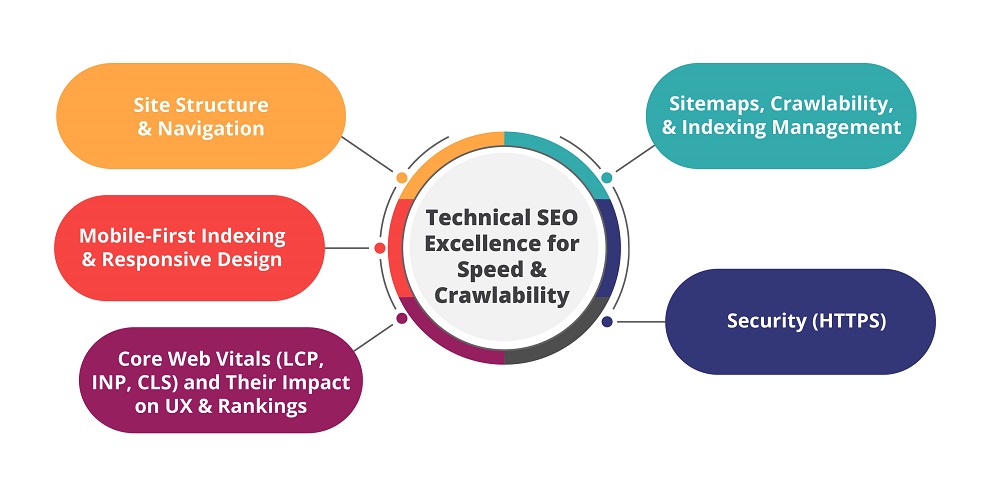
Site Structure & Navigation
An SEO-friendly site is crucial for ranking in the Google search console. The website should be easily navigable by the user. The content and pages should be well-organized so that even a new user can easily access the site without hesitation. A well-designed website should have access to every product in the eCommerce within three clicks from the homepage. This streamlined navigation enhances the user experience and signals to the search engine that the website is easy to navigate, thereby improving overall SEO.
For mobile users, the navigation menus should be easy to use. Collapsible menus with a hamburger icon work the best. Limit dropdown options to only seven categories. A breadcrumb trail is to be added to improve the user experience and help users understand their current location on the site, as well as easily navigate back to previous pages. Breadcrumbs make it easier for search engine bots to crawl the site and appear in schema markup, providing users with informational content before they even enter your website.
Additionally, incorporating descriptive and keyword-rich URLs is crucial. Use hyphens instead of underscores and maintain URLs in lowercase, making it easier for search engines to understand the content of the pages.
Mobile-First Indexing & Responsive Design
Google’s default mobile-first indexing means that the mobile version of a site is the primary factor considered by the search engine for ranking. Therefore, websites should be optimized for various screen sizes, including those of smart devices such as mobile phones, tablets, and laptops. This ensures a consistent, high-quality user experience across all devices, which is important for product pages and the checkout process; otherwise, it can lead to abandoned carts. Simplified mobile navigation features, including large, easy-to-tap buttons and smart autocomplete suggestions in search bars, reduce bounce rates and improve conversions, which is the result of best eCommerce SEO practices.
Core Web Vitals (LCP, INP, CLS) and Their Impact on UX & Rankings
Core web vitals are considered direct ranking factors by the Google search engine, which influences website performance and user experience. If these metrics are not up to the mark, it can lead to a lower ranking, fewer conversions, and an increase in bounce rate. Google ranks websites based on the ultimate user experience they provide to users.
Core web vitals are of three types. They are:
- Largest Contentful Paint (LCP): This measures the loading speed of the largest visible content element on the page. A “good” LCP score is under 2.5 seconds. Optimization involves improving server response time (TTFB), utilizing a Content Delivery Network (CDN), deferring non-critical JavaScript and CSS, and compressing images while serving them in modern formats, such as WebP.
- Interaction to Next Paint (INP): Measures the interactivity of a page, capturing the delay between a user interaction, such as a click or tap, and the browser’s response. A “good” INP score is under 200 milliseconds. This focuses on ensuring a smooth and responsive user experience.
- Cumulative Layout Shift (CLS): This metric indicates the visual stability of a page, measuring the amount of content that shifts unexpectedly while the page is loading. A “good” CLS score is under 0.1. To optimize, ensure images and videos have proper dimensions and reserve space for dynamically loading content to prevent layout shifts.
Research suggests that improvements in core web vitals lead to business growth. For example, if you can make your website 100 milliseconds faster, the conversion rates will improve by 1%. If the pages load within 1 second, they have a three times lower bounce rate than the pages that take 5 seconds to load. Additionally, mobile users tend to leave the site if it takes more than 3 seconds to load.
When a website has poor technical SEO, such as slow loading times, a poor mobile experience, or broken links, it can increase bounce rates, which directly impact search engine rankings. Improvements in technical SEO can attract more traffic and lead to increased sales.
Sitemaps, Crawlability, and Indexing Management
Submitting a sitemap to Google Search Console is crucial for improving search engine rankings. By doing so, the search bots will index all the necessary pages whenever you add any useful content, promotions, and offers for your users. Regular site audits are essential for identifying and resolving issues within the website, such as broken or redirected links, which can help conserve the crawl budget. Search engines have a limited crawl budget. Therefore, ensure that the important pages are submitted for indexing, which keeps the site efficient and search-friendly.
Security (HTTPS)
Implementing HTTPS (via an SSL certificate) has been confirmed as a Google ranking signal. Ensuring website security and building user trust are top priorities.
2. On-Page Optimization for User Intent & Conversions
In 2025, on-page optimization requires a clear understanding of user intent and a focus on enhancing conversion rates through multiple approaches. Search engines have evolved to the point where they no longer match keywords; instead, they focus on user intent, which is a major trend in eCommerce SEO best practices. Therefore, it’s no longer about using the right keywords; it’s about creating the right content that’s helpful to users.
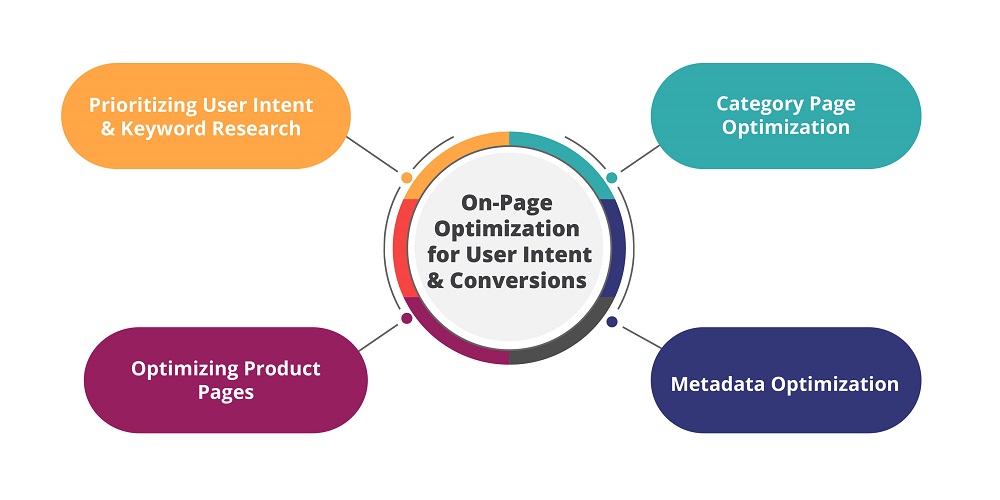
Prioritizing User Intent & Keyword Research
Understanding the intent behind a customer’s search query is important for effective on-page optimization. Content must directly address the actual intent of queries—whether informational, navigational, transactional, or local. This ensures that content aligns with users at every stage of their buying journey. Thorough keyword research and long-tail phrases are crucial for aligning closely with the natural language of the user. Utilize tools like Semrush, Google Keyword Planner, or Google Autocomplete for valuable insights. This is an ongoing process as Google’s search trends and algorithms evolve.
Optimizing Product Pages
Product pages are the key conversion points for any e-commerce business, and following best eCommerce SEO practices to optimize them can significantly improve sales. Create product descriptions by understanding the user’s intent rather than just aligning keywords. Use original content for the descriptions to avoid duplicate content issues, but try to give your brand a unique voice. You should include keywords in a way that naturally flows with the content. Highlight the unique selling points to improve the conversion rate for users.
Use high-quality and detailed product images. Utilize 360-degree visuals of the product to provide a better understanding for the customer. Compress the images to improve the load time. Do not forget to add alt text for the images for both accessibility and SEO purposes. Adding location-specific keywords to the titles and descriptions can attract local customers. Requesting reviews from local customers and displaying them on your website can help build trust and credibility for your brand.
Implementing specific schema types is crucial for eCommerce to provide detailed, machine-readable information to search engines. This increases the chances of earning rich snippets in SERPs and improves visibility within Google’s Shopping Graph.
Thin, generic, or duplicate content can confuse search engines about which page to rank and weaken your site’s SEO. On the other hand, unique, high-quality content that focuses on user intent keeps visitors engaged longer and sends strong signals to search engines about your site’s value. For eCommerce businesses, you need to create detailed, informative, and compelling product and category pages that tell a story, highlight benefits, and answer potential buyers’ questions. Adding structured data like product specs, reviews, and pricing to help search engines understand your content, as well as feature proofs like customer reviews to boost click-through rates and build trust, especially in the age of AI-driven search results. By offering rich, well-researched, and user-approved content, you’re not just improving SEO—you’re building a stronger, more trusted brand that both search engines and customers will favor.
Category Page Optimization
Category pages serve as a guide for customers looking for a specific product. These pages should include a description that provides an overview of the products within that category. Include relevant FAQs that address common queries and provide relevant content within them. Provide comprehensive filter and sort options to allow users to find the products they are looking for based on the attributes. Implement proper internal linking within product and category pages, as well as other relevant guides, to improve bot crawling. This helps to enhance the user experience and product discovery.
Metadata Optimization
Creating strong title tags and meta descriptions is crucial for attracting both search engines and users. A proper title tag should ideally have 50–60 characters, incorporating relevant keywords, and clearly describe the page’s content. It is the first thing users see, so it needs to be compelling. Additionally, your meta description should be approximately 50–160 characters in length and function like a mini ad by providing a concise summary of the page’s content, and include a call to action if possible.
3. Content Strategy & Topical Authority
The evolution of search is continually improving due to advancements in AI. So, follow the best eCommerce SEO strategies by creating knowledgeable and trustworthy content to achieve better rankings rather than just checking the SEO boxes.
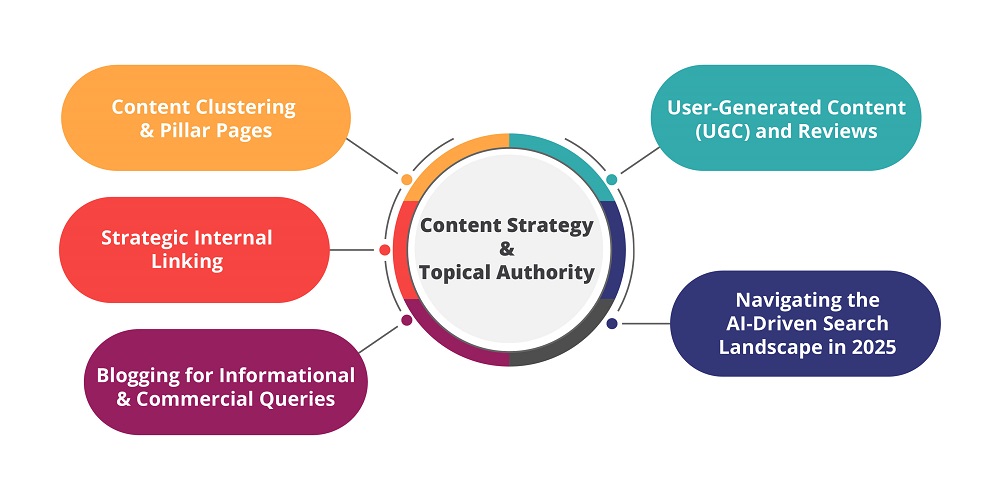
Content Clustering & Pillar Pages
Pillar and cluster strategy works well. Enhance both SEO and user experience by organizing your site around broad topics (pillar pages) and supporting them with detailed subtopic pages (clusters). Pillar pages target high-traffic keywords and serve as central hubs, while cluster pages focus on specific long-tail keywords and link back to the pillar pages. This structure makes content easier to navigate, improves search engine crawlability, and establishes strong topical authority—a key factor in achieving higher rankings and visibility, especially in AI-driven search results that favor well-organized, authoritative sources.
Strategic Internal Linking
Strong internal linking is crucial for helping search engines crawl and index your site efficiently, as well as distributing link juice across your eCommerce pages. Leveraging tools like AIOSEO’s Link Assistant, you can simplify the process by utilizing internal link suggestions and identifying orphaned pages. Well-planned internal links should have a clear and logical structure to enhance user navigation and strengthen your site’s content hierarchy.
Blogging for Informational & Commercial Queries
Maintain an active blog to support your business online. While product pages help sell, blog posts attract more visitors by providing helpful information. You can write blog posts about how to use and take care of your products, how they solve everyday problems, or tips that relate to your industry. Lifestyle articles, expert advice, or updates about what’s happening in your field can also draw attention. Update your blog regularly so that Search engines and users can have fresh content.
User-Generated Content (UGC) and Reviews
Apart from product pages, incorporating user-generated content (UGC) and customer reviews into your website can help build strong trust with visitors. It’s important to make sure all reviews and UGC are honest and authentic content for long-term credibility. Customer images and videos show that real people are using your products. Additionally, fake and AI-generated unedited content can harm your website’s rankings. Updates like Google’s helpful content update ensure that online businesses focus more on strategy and quality.
Navigating the AI-Driven Search Landscape in 2025
AI Overviews and smart search engines are transforming eCommerce in a big way. Therefore, to stay ahead in this competitive market, it is essential to follow the best eCommerce SEO practices.
4. Understanding Google AI Overviews (SGE) and Their Impact
Google’s AI Overviews, previously known as Search Generative Experience (SGE), utilize generative AI to provide answers and insights. These answers are sourced from various websites, displayed above the web, alongside traditional and organic listings. These are immediate answers that function as feature snippets with sources attached, allowing users who want to delve deeper into the content to do so.
Impact on CTR and Zero-Click Searches
AI Overviews occupy a significant portion of the top of search results. AI overviews push regular organic listings so far that users have to scroll halfway down to see the first traditional result. Studies show that when AI Overviews appear, click-through rates (CTR) for organic listings drop. Amsive states that there is a 15.49% average drop in CTR for keywords that show AI Overviews and a much steeper 27.04% drop for pages that rank below the third position. Research from Moz suggests that some websites could lose between 18% and 64% of their organic traffic, particularly those offering basic informational content. This is part of the growing trend of “zero-click searches,” where users receive the answers they need directly on the search page without needing to visit a website.
As search engines become more like answer engines, getting that top spot on the results page isn’t enough anymore. eCommerce teams now need to follow the best eCommerce SEO practices and focus on showing up in AI Overviews and optimizing for transactional keywords that still lead to clicks and conversions.
5. Adapting to AI Overviews
The evolving nature of search requires a proactive and adaptive approach to SEO.
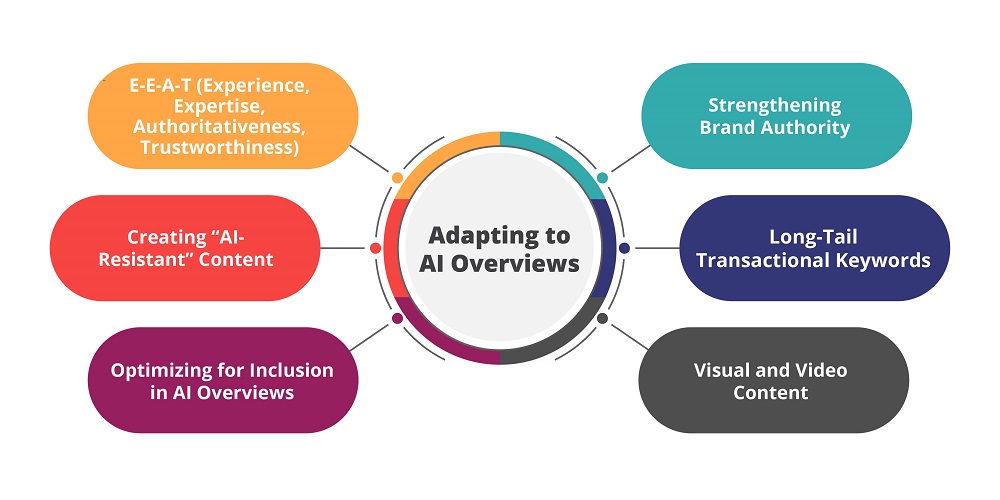
E-E-A-T (Experience, Expertise, Authoritativeness, Trustworthiness)
E-E-A-T (Experience, Expertise, Authoritativeness, and Trustworthiness) is more important when it comes to AI Overviews. That’s because AI Overviews are based on Google’s core search systems, including the Helpful Content System, which looks for high-quality, trustworthy content. A recent study found that AI-driven search engines discovered that improving E-E-A-T in content made a significant difference.
For eCommerce sites, E-E-A-T is crucial for both the website level and the product level. You need a smooth and trustworthy checkout process, and your product pages should include features like customer reviews and star ratings to build confidence. To boost E-E-A-T in your content, cite reliable sources, include stats from trusted organizations, and write in a confident, expert tone. Publishing your research, featuring expert interviews, or sharing firsthand experiences can also help. Google’s AI Overviews tend to favor content that clearly shows real-world experience and strong knowledge in your niche.
Creating “AI-Resistant” Content
Create original content so that AI struggles to duplicate it because of the originality, depth, and human intervention. The strategies are mentioned below:
- Publishing Proprietary Research: Conducting studies and surveys and publishing unique data provides fresh insights into the industry. AI models gather information from existing sources, so they cannot generate or summarize data that does not already exist.
- Interviewing Industry Experts: Adding insights and opinions of the industry experts in that particular field. AI cannot fabricate these unique perspectives.
- Creating In-Depth Product Comparisons with Subjective Judgment: While AI can summarize feature lists, it struggles with subjective opinions, detailed comparisons, and personal recommendations that involve human decision-making.
- Writing Case Studies with Real-World Applications: AI cannot duplicate genuine customer experiences, success stories, or business challenges. Detailed case studies with tangible results make content more irreplaceable, practical, and engaging.
- Developing Step-by-Step, Highly Detailed ‘How-To’ Guides: AI can generate general guides, but it cannot explain complex tasks in detail. Content with a step-by-step breakdown, especially when combined with screenshots, video tutorials, or interactive elements, can improve customer engagement and retention.
- Creating Content with Depth and Complexity: AI excels at summarization but struggles to provide in-depth analysis. Publishing complete, in-depth, and expert-backed content with topics from multiple angles will make content difficult for AI to replace.
Optimizing for Inclusion in AI Overviews
To get your content featured in AI Overviews, it’s essential to keep your content concise, clear, and well-organized. The main sections should be labeled in H1 to make it easier for AI to understand and extract information from your page. Using structured data is also key. Since AI Overviews rely on Google’s Shopping Graph, which pulls information from the Google Merchant Center and pages with Product markup, adding proper schema helps your content get recognized. Target common follow-up questions shown in AI Overviews or the “People Also Ask” box and answer them on your site to increase your chances of being featured in those high-visibility spots.
Strengthening Brand Authority
AI Overviews highlight content from trusted, authoritative sources. That’s why businesses need to build credibility across the web. Earning backlinks from reputable websites within your industry is a viable option for establishing trust and credibility. These act like trust signals that tell search engines your site is reliable. You can also build authority by publishing expert-led content, adding author bios with real credentials, and sharing insights from experienced professionals. Regularly updating your content with new reports, expert references, and fresh insights helps keep it competitive and relevant. These efforts not only build your brand but also increase the likelihood that AI will incorporate your content into Overviews.
Long-Tail Transactional Keywords
As the AI overview is mainly focused on informational queries, it is essential to target long-tail transactional keywords. These searches are less affected by AI overview and mostly come from customers who are about to make a purchase.
Visual and Video Content
Visual and video content are gaining popularity as a means of providing content. It enhances engagement and provides rich, informative imagery that is increasingly utilized by AI-driven search engines. It is one of the best eCommerce SEO practices for gaining customers’ trust.
6. Emerging Trends & Future Outlook
eCommerce SEO is directly linked to advancements in AI technology. We are observing a shift towards a more personalized and efficient user experience. To stay competitive, businesses must adapt their SEO strategies—not just to reflect how people search but also to consider data privacy. AI is driving these changes, and staying competitive means adapting to this new approach to search.

Voice Search Optimization
Voice search is quickly becoming a major part of eCommerce. By 2025, it’s expected that 75% of local searches will be through voice. To appear in voice search results, your content must match how people speak. That means using conversational, long-tail keywords instead of short, typed phrases. Structuring content in a way that answers questions—especially in FAQ sections—also helps your site get featured in voice-friendly search snippets. Additionally, your website should be fast-loading and function well on mobile devices, as most voice searches occur on phones or smart devices, and users expect prompt answers.
Visual Search Optimization
Visual search is popular among shoppers who use images to find similar products or to make a purchase. The global visual search market is projected to reach USD 150.43 billion by 2032. Optimization strategies include using high-resolution, clear product images from multiple angles, including descriptive alt text with relevant keywords, and using image sitemaps to ensure crawlability. Implementing Product Schema for images helps search engines understand product data for visual queries. Providing contextual information around images and maximizing the use of platforms like Pinterest and Instagram, which are major players in visual search, are also key. User-generated content, such as customer photos, can also appear in visual search results, highlighting the importance of encouraging and leveraging it.
Personalized Search
AI and machine learning are the driving forces behind personalized search in eCommerce. They analyze huge amounts of data to spot patterns, understand user intent, and deliver fast, highly relevant search results. With personalized search, results are tailored to each user’s preferences, location, and past behavior. This means product listings update in real-time to match what each customer is looking for more closely, creating a more helpful and personalized shopping experience. This leads to several benefits:
- Lower Bounce Rates: Users are more likely to find what they are looking for quickly, resulting in longer engagement and lower abandonment rates.
- Increased Average Order Value (AOV): AI-driven product search can present smart suggestions and show related products, effectively marketing upsells and cross-sells during the shopping process.
- Higher Conversion Rates: Customers are more likely to purchase if they view exactly what they are looking for or discover products they did not know they wanted.
- Enhanced Customer Loyalty: Personalization creates more consumer happiness and loyalty, as customers are likely to return to a brand that “knows” them.
Strategies for personalized search include monitoring behavioral data, geo-based customization, and proper product categorization and tagging to enable improved filtering and intent-based recommendations. AI-driven tools can easily automate the entire process, delivering personalized experiences across multiple touchpoints, from email campaigns to in-store product recommendations.
AI in Technical SEO, UX/CRO, and Content Creation
AI is being leveraged across various SEO functions:
- Technical SEO: AI helps make eCommerce SEO more efficient by handling time-consuming tasks and supporting smarter decisions, such as analyzing data and building an internal linking strategy, which saves time and resources.
- User Experience (UX) and Conversion Rate Optimization (CRO): AI enhances user experience and conversions by providing AI-powered product recommendations, chatbots for customer support and product discovery, as well as UX/CRO audits based on user behavior analysis.
- Content Creation: AI tools are used to create product descriptions, meta titles, descriptions, and alt text. They also assist in developing blog posts, landing pages, FAQs, and brainstorming content ideas while ensuring brand voice consistency and enhancing grammar and clarity. However, it is essential to note that Google penalizes low-effort AI-generated content, prioritizing the importance of originality and human oversight.
Prioritizing Privacy-First Data Collection
With the implementation of strict data privacy laws and the impending end of third-party cookies, SEO strategies will need to prioritize first-party data collection in 2025. Brands will need to build trust by adopting privacy-first policies. This involves optimizing content for privacy-conscious users and developing strategies that do not rely heavily on tracking, instead focusing on creating content that aligns with user needs and their search queries.
Common Challenges & Adaptations
SEO is ever-changing as Google updates its algorithms. That is the reason businesses cannot afford to take the “set it and forget it” approach. Instead, they need to review the content regularly and deliver a great user experience, as well as fresh and relevant content to users. Implementing best SEO practices for your eCommerce business needs to be flexible, and the common challenges in implementing them are as follows:
Algorithm Updates
Google continuously optimizes and updates its algorithm, making it challenging for businesses. Recent updates, including Core Web Vitals (2021), Product Reviews Updates (2021–2023), and Helpful Content Updates (2022–2024), have had a significant impact on eCommerce SEO. The March and May 2024 Core Updates, in particular, strengthened spam signals and quality thresholds, targeting AI-generated, low-value content and focusing on surfacing truly useful, original pages. This means that low-quality content, particularly auto-generated product pages with minimal text or descriptions, will rank well in search results.
Targeting Wrong Keywords
A common challenge is targeting the wrong keywords, primarily focusing on short-tail keywords that don’t deliver the desired results. The solution is to do research and apply keywords that match your audience, including long-tail phrases.
Low-Quality AI-Generated Content
While AI tools assist in content creation, low-effort, unoriginal AI-generated content can be penalized by Google. AI programs can also generate false information, which, if not properly verified, can potentially harm an organization’s reputation. The solution is to use AI as a starting point, not a final draft, layering in brand voice, expertise, and customer data and prioritizing originality with real examples.
Monitoring & Analysis
SEO campaigns generate a substantial amount of data, making it challenging to determine what truly matters. In today’s AI-driven world, tracking metrics such as impressions, search visibility, and brand mentions provides a clearer picture of how your content is performing and how your brand is presenting itself online. Regularly monitoring these helps you stay on top of what’s working and what needs improvement.
Conclusion
As search continues to evolve with AI, voice search, and stricter privacy rules, eCommerce SEO is no longer just about keywords and rankings. Therefore, following best eCommerce SEO practices is crucial. It’s about creating helpful, trustworthy content that directly addresses user needs, building credibility across the web, and staying adaptable in a rapidly changing digital landscape.
If you’re ready to future-proof your eCommerce strategy and stay ahead in this AI-driven world, Ayatas Technologies can help. Our team specializes in smart and modern eCommerce development services that bring long-term results. Let’s take your digital presence to the next level. Contact us today for a free quote!